Request a Free Property Evaluation
Nationwide Net Lease Expertise
Contact Our Advisory Team Today
Request a Free Property Evaluation
Nationwide Net Lease Expertise
Contact Our Advisory Team Today

Delaware Statutory Trust

DST

DST Ownership and Investment Structure

DST Ownership and Investment Structure

A streamlined structure offering passive, tax-efficient access to institutional-quality real estate with professional management and limited investor liability.

A Delaware Statutory Trust allows investors to own a pro rata beneficial interest in real estate through a professionally managed trust structure. While investors do not hold deeded title to the property, they are entitled to receive distributions generated from rental income and the eventual sale of the asset. The trust itself holds the deed and retains decision-making authority over the property’s operation and disposition. This structure provides retail investors access to institutional-grade real estate while enabling diversification across asset classes, sectors, and geographic demographics through a turnkey investment solution without the responsibilities of active property management.

DSTs and 1031 Tax-Deferred Exchanges

DSTs and 1031 Tax-Deferred Exchanges

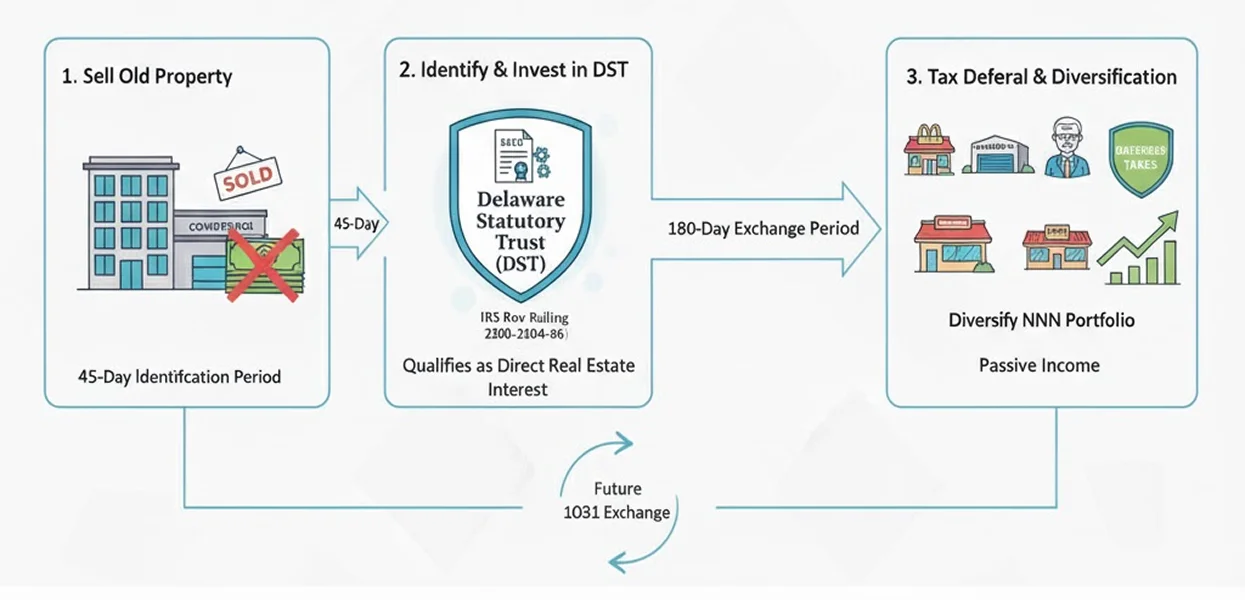
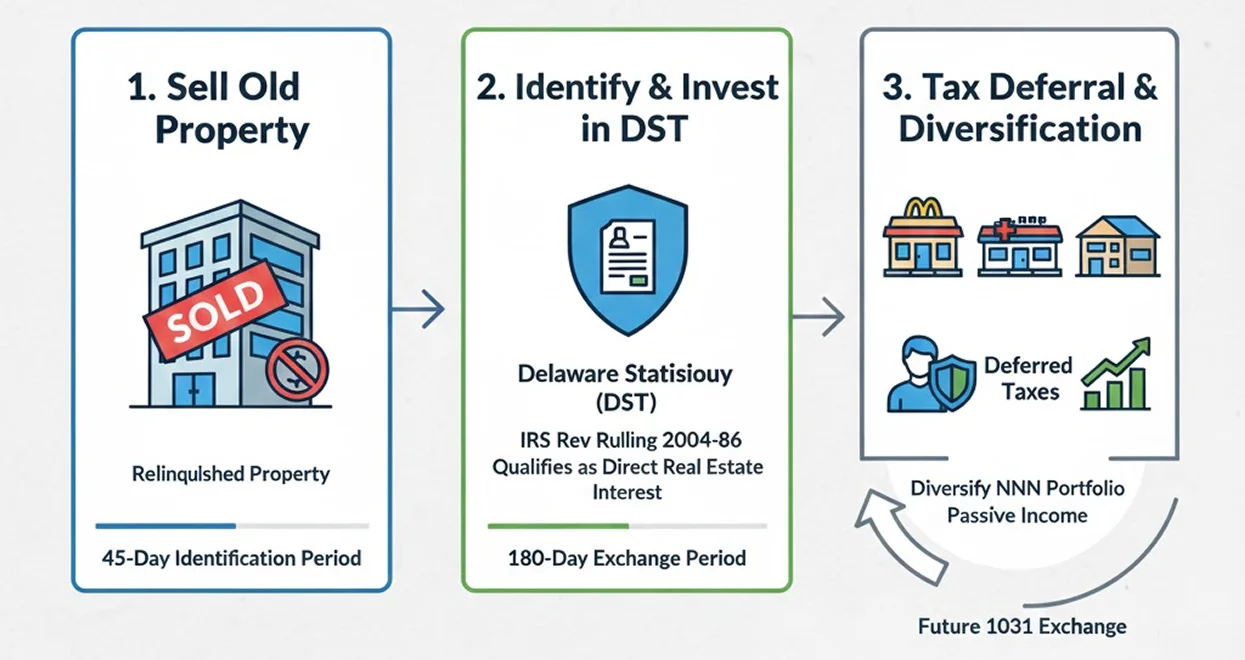
For purposes of a 1031 tax-deferred exchange, the purchase of a beneficial interest in a DST is treated as a direct interest in real estate under IRS Revenue Ruling 2004-86, provided all other exchange requirements are satisfied. This allows DSTs to be used as replacement property in a 1031 exchange and has made them a common ownership structure for investors seeking tax deferral. DSTs can also benefit investors who are not currently completing a 1031 exchange, as the investment maintains its treatment as a direct real estate interest and may qualify for a future 1031 exchange when the underlying property is sold.

Legal Framework, Tax Treatment, and Operational Limitations

Legal Framework, Tax Treatment, and Operational Limitations

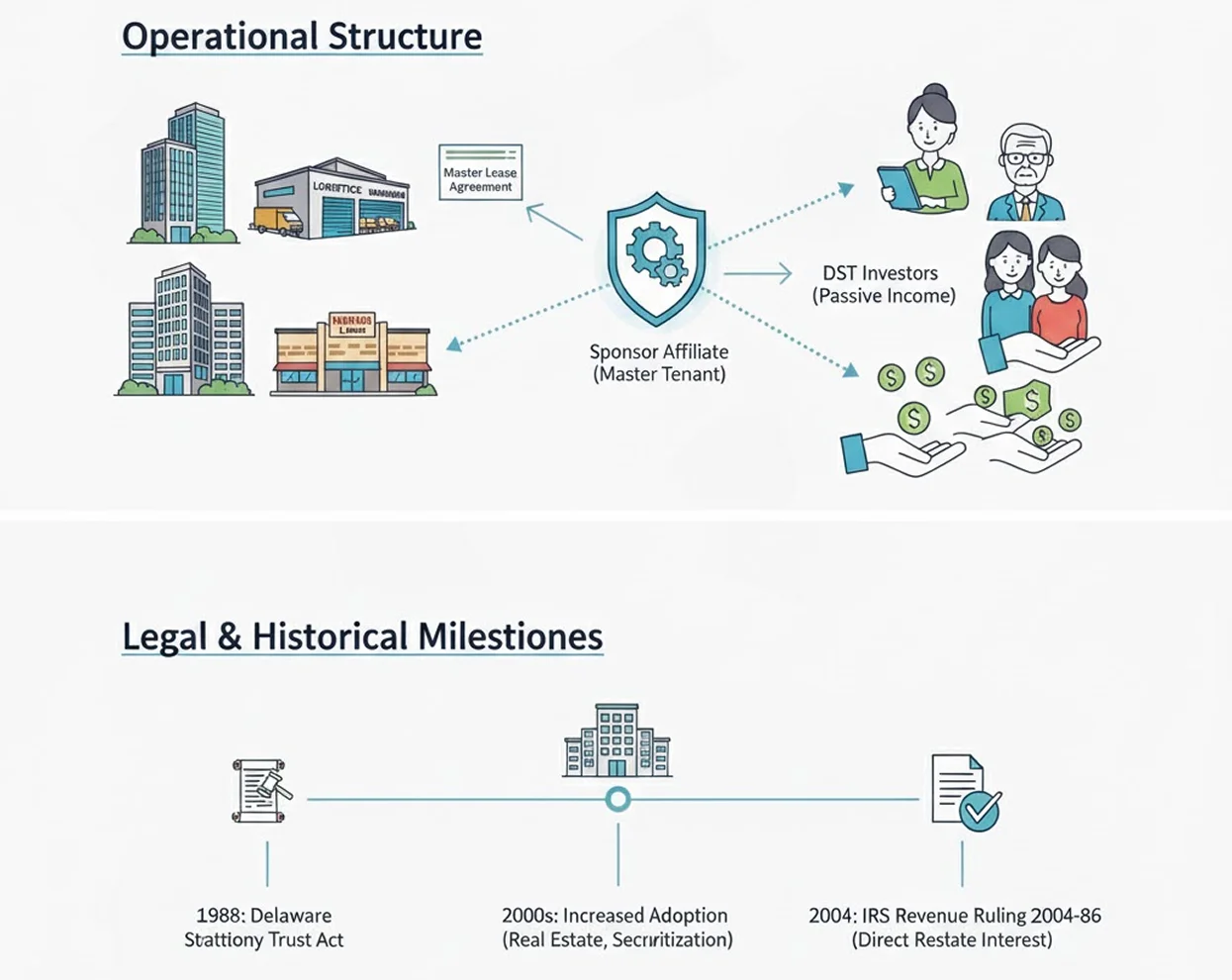
A Delaware Statutory Trust operates similarly to a unit or fixed investment trust, in which assets such as real estate are acquired, held, and ultimately sold, with all income, losses, and tax attributes passed directly to investors since the trust is not considered a taxable entity. Due to legal and financing constraints, DST properties are typically leased to a sponsor affiliate acting as a master tenant under a triple-net master lease, which limits operational flexibility but enhances stability. Although business trusts date back to 16th-century English common law, statutory trusts were formally recognized with the passage of the Delaware Statutory Trust Act in 1988. Since 2000, and particularly following IRS clarification in 2004, DSTs have been widely adopted for tax deferral, asset protection, and efficient real estate ownership.

Delaware Statutory Trusts play an increasingly important role in tax-deferred real estate strategies, especially for investors seeking diversified, professionally managed income-producing properties. At NNN Investment Advisors, we can help you understand how DSTs integrate with your broader net lease and 1031 exchange goals and connect you with relevant offerings that meet your investment criteria.

Contact Us Now
DST Benefits

Delaware Statutory Trust (DST) Benefits

A streamlined structure offering passive, tax-efficient access to institutional-quality real estate with professional management and limited investor liability.

No Need for Unanimous Owner Approval

DSTs eliminate unanimous investor approval, empowering trustees to act decisively during adverse conditions to restructure financing, renegotiate leases, or sell assets.

Less Expensive, Easier Financing

DST financing is simpler and more cost-effective because lenders deal with one borrower, eliminating multiple approvals and protecting individual investors’ personal credit ratings.

No Need to Sign Loan Carve-Outs

DST investors have no voting authority, eliminating fraud carve-outs, while lenders rely solely on the sponsor or trustee for all non-recourse loan obligations and protections.

Limited Personal Liability

DST investors benefit from limited liability protections, safeguarding personal assets, with bankruptcy-remote provisions ensuring losses are generally limited to their invested capital only.

Lower Minimum Investment

DSTs allow lower minimum investments due to larger investor pools, with cash entries around $25,000 and typical 1031 exchange minimums near $100,000 for investors.

No Closing Costs

DST investors typically have no closing costs, saving up to $5,000 per investment, helping maximize returns, reduce upfront expenses, and preserve capital across real estate offerings.

No Need to Maintain an LLC

DST investors do not need to maintain an LLC, avoiding annual state filing fees that dilute cash flows and helping preserve returns, simplicity, and long-term investment efficiency over time consistently.

No Trustee Term Time Limit

The DST trustee is typically the sponsor or affiliate, with no term limits, giving lenders confidence the sponsor maintains a stable, ongoing presence in property operations.

No Inadvertent Termination

A DST includes a statutorily required Delaware trustee, ensuring the trust will not inadvertently terminate and providing long-term structural stability and compliance for investors.